


 Home
HomeResearcher Vladimir Mikhailov from Shandong Institute of Advanced Technology (SDIAT) Wins "Qilu Friendship Award"
Release date: 2025-12-09
Visits: 708
Source: 山东高等技术研究院
Recently, Vladimir Mikhailov, a Russian researcher from the Particle Physics Research Center of SDIAT, was awarded the 2025 "Qilu Friendship Award" for foreign experts by Shandong Provincial People's Government. As the highest honor conferred by the Shandong Provincial People's Government on foreign experts, the "Qilu Friendship Award" aims to recognize foreign experts who have made outstanding contributions to Shandong's modernization drive and China's international exchange initiatives.
Recently, Vladimir Mikhailov, a Russian researcher from the Particle Physics Research Center of Shandong Institute of Advanced Technology (SDIAT), was awarded the 2025 "Qilu Friendship Award" for foreign experts by Shandong Provincial People's Government. As the highest honor conferred by the Shandong Provincial People's Government on foreign experts, the "Qilu Friendship Award" aims to recognize foreign experts who have made outstanding contributions to Shandong's modernization drive and China's international exchange initiatives.
Researcher Profile
Researcher Profile
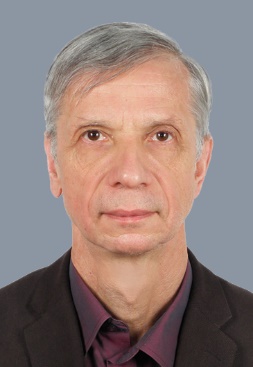
Vladimir Mikhailov, male, born in 1963, is a Russian national who previously served as a Chief Scientist at Moscow Engineering Physics Institute. He joined Shandong Institute of Advanced Technology in 2023 and currently holds the position of Researcher at the Particle Physics Research Center. He is also a recipient of China's National High-Level Talent Program.
Professor Mikhailov's research primarily focuses on particle astrophysics and space physics. He has participated in numerous large-scale space experiments, including the former Soviet Union's Maryia series, the Russia-Italy cooperative NINA-RIM series, and the PAMELA experiment. He has achieved a series of significant research outcomes in areas such as cosmic ray experimental measurements, near-Earth orbit radiation environment, and solar modulation models, with profound expertise in space science experiment design, detector development and testing, ground control system operation, and experimental data analysis and theoretical interpretation. Since 2015, as one of the core scientists, Professor Mikhailov has been dedicated to advancing the next-generation space gamma-ray astronomy experiment, contributing to experimental concept development, detector design, and key technology research and development.
Researcher's Achievements
Since taking up full-time work in China in 2023, Professor Mikhailov has made remarkable contributions to basic cosmic ray research in the AMS experiment, China-Russia scientific and technological cooperation and exchanges, and the introduction and training of young talents.
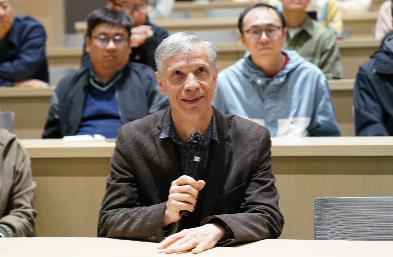
Meanwhile, Professor Mikhailov has actively built a bridge for China-Russia scientific and technological exchanges. He mobilized Russian scholars to participate in the International Symposium on Heliospheric Cosmic Rays hosted by SDIAT and organized the China-Russia Cosmic Ray Research Forum. He invited scholars from renowned universities and research institutions in China, Russia, and the United States, including Moscow Engineering Physics Institute, National University of Science and Technology Moscow, Lebedev Physical Institute, and Massachusetts Institute of Technology, to exchange ideas on cutting-edge progress and explore technological cooperation. He has also actively promoted SDIAT 's joint applications for multiple national-level international cooperation projects with Russian institutions, facilitated academic exchanges and mutual visits of graduate students between Chinese and Russian universities, built a platform for academic further education for young students from both countries, and supported cross-border talent training.
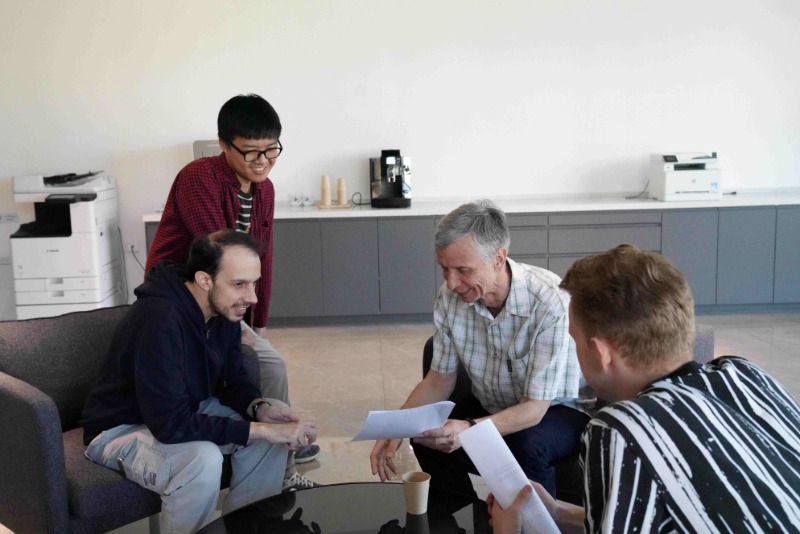
In addition, Professor Mikhailov is committed to the introduction and training of young talents. He has carefully guided young scholars in AMS data analysis, making important contributions to the institute's team in gaining advantages in areas such as cosmic ray anisotropy, nuclear flux, and isotope measurements. He has actively promoted interdisciplinary research on cosmic rays and space radiation, guided research on space particle radiation environment and atmospheric secondary cosmic ray modeling, and offered core professional courses benefiting numerous graduate students and young scholars. Furthermore, he has actively promoted Shandong's scientific and technological talent policies in Russia, successfully attracting high-end foreign talents to join the institute and injecting international vitality into talent introduction.
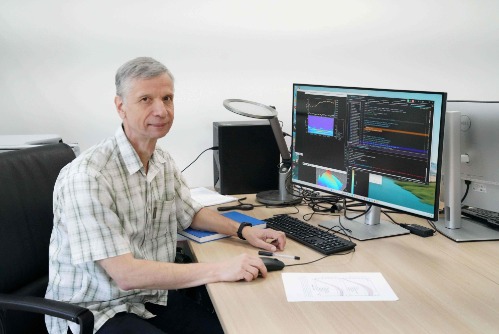
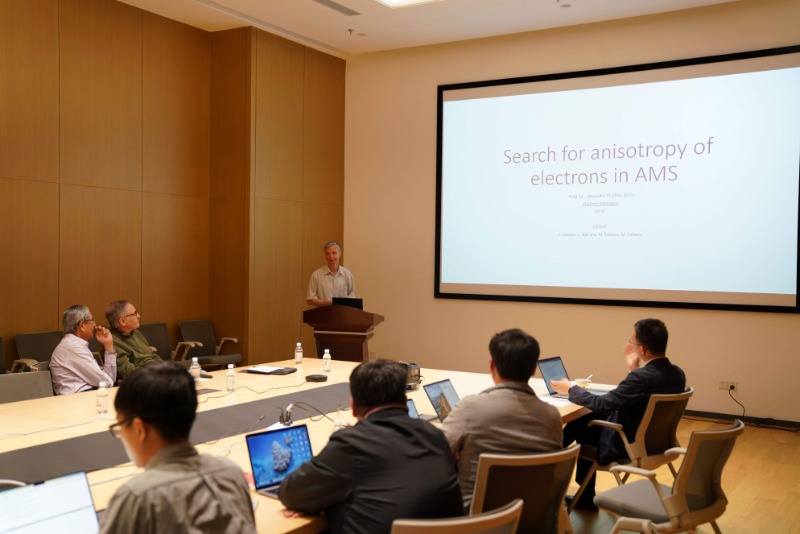
As a core member of the AMS team, Professor Mikhailov has deeply engaged in basic cosmic ray research, providing key support for several collaborative papers published in the top journal Physical Review Letters (PRL). These achievements have garnered widespread attention in the physics community, with two papers selected as PRL Editors' Suggestions and highlighted in Physics, a magazine of the American Physical Society.
Meanwhile, Professor Mikhailov has actively built a bridge for China-Russia scientific and technological exchanges. He mobilized Russian scholars to participate in the International Symposium on Heliospheric Cosmic Rays hosted by SDIAT and organized the China-Russia Cosmic Ray Research Forum. He invited scholars from renowned universities and research institutions in China, Russia, and the United States, including Moscow Engineering Physics Institute, National University of Science and Technology Moscow, Lebedev Physical Institute, and Massachusetts Institute of Technology, to exchange ideas on cutting-edge progress and explore technological cooperation. He has also actively promoted SDIAT 's joint applications for multiple national-level international cooperation projects with Russian institutions, facilitated academic exchanges and mutual visits of graduate students between Chinese and Russian universities, built a platform for academic further education for young students from both countries, and supported cross-border talent training.
“When I joined the AMS experiment on ISS a few years ago, and listened to the reports and presentations of various groups, I thought that SDIAT was one of the major institutions in the collaboration, which participates in almost all explorations. After, I was surprised to know that the institute has only recently been established. Of course, the decision to come to China was not easy, many different factors influenced it. But the main thing, of course, is work. My first impressions have been correct. There are many young scientists and students in the Particle Physics Research Center, they work with enthusiasm and energy on many tasks of the AMS-02 experiment and those close to them. The Computational Science Research Center is growing rapidly and has great potential for data processing and theoretical calculations. I believe that these efforts will bring results, result in new projects, new ideas and discoveries.” ——Vladimir Mikhailov