


 Home
HomeLandmark Discovery Sheds Light on Cosmic Element Origins: Shandong Research Team Unravels the Mysteries Behind Five Cosmic Elements
Release date: 2026-06-23
Visits: 203
Source: 山东高等技术研究院
Where Do Cosmic Phosphorus, Chlorine, Argon, Potassium and Calcium Originate? A Shandong Research Team with an Average Age Under 35 Uncovers the Answer
On the evening of June 17, Beijing Time, the Alpha Magnetic Spectrometer (AMS) experiment mounted on the International Space Station, led by Nobel Laureate in Physics Professor Samuel C.C. Ting and with core participation from the Shandong Institute of Advanced Technology, released its latest research findings. The team measured the energy spectra of the five aforementioned cosmic ray nuclei with unprecedented precision, extending the measurable energy range to teraelectronvolts for the first time. It also identified a new universal pattern: the energy spectra of all 20 nuclei measured to date fall into two primary components and two secondary components, marking a landmark discovery in probing the origin of cosmic elements.
How formidable was the research challenge? Since its launch in 2011, the AMS has recorded over 250 billion cosmic ray data points in total. Xu Weiwei, a researcher at the Shandong Institute of Advanced Technology, and his colleagues spent nearly six years precisely screening out one million target nuclear samples from this massive dataset.
Particle discrimination posed an even greater hurdle. When heavy cosmic ray nuclei pass through the AMS detector, they collide with thin layers of material lining the detector’s exterior and fragment, much like bullets piercing a wall — an iron nucleus, for instance, may split into chlorine or argon. When the detector captures a signal, how can researchers distinguish whether it comes from an intact original nucleus or a fragmented one? The team repeatedly measured fragmentation probabilities and assessed background noise, ultimately overcoming this technical bottleneck. The resulting observations boast the broadest energy coverage and highest precision achieved in related research to this day.
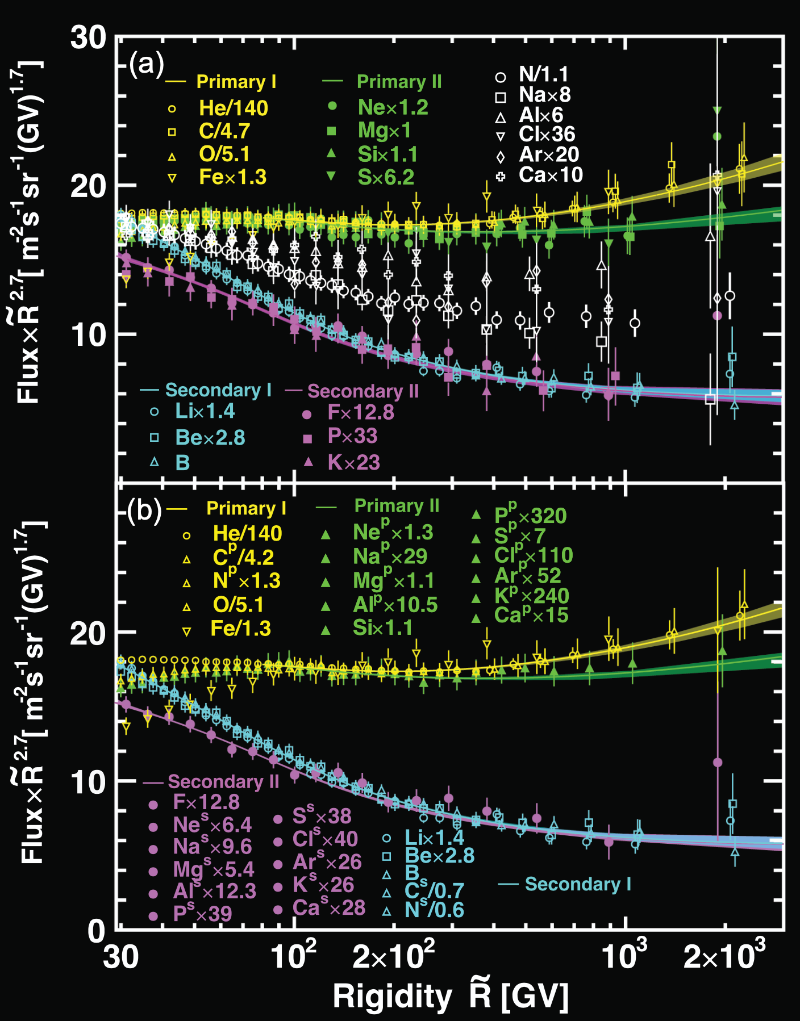
The new results reveal two pivotal cosmic laws. First, each of the five elements exists in both primary and secondary forms: primary nuclei stem from celestial events such as stellar explosions, while secondary nuclei form from the fragmentation of heavier atomic nuclei. Even-numbered nuclei argon and calcium carry a far larger proportion of primary components than odd-numbered phosphorus, chlorine and potassium. Second, all 20 nuclear energy spectra measured by the AMS collaboration fit the classification of two primary and two secondary component categories.
What does this breakthrough mean for understanding the origin of cosmic elements? According to Xu Weiwei, the universe began with the Big Bang, which initially produced only hydrogen and trace helium. Every element lighter than iron thereafter formed via nuclear fusion inside stars. The elemental abundances and energy spectra obtained in this study serve as fundamental benchmark data that all theoretical models of cosmic element formation must align with.
The AMS collaboration unites roughly 260 researchers across 48 scientific institutions worldwide, and the Jinan-based Shandong Institute of Advanced Technology occupies an indispensable position within this global partnership. It hosts the world’s largest public cosmic ray science database, where the majority of global AMS simulation work is conducted. Young researchers including Xu Weiwei, Wang Zhaomin and Zhang Jin, who led core data analysis, represent the rising generation of scientists within the AMS consortium.
The AMS detector is set to undergo a major upgrade in the near future. Post-upgrade, the detector will collect as much high-energy cosmic ray data in one year as it previously gathered over three years. The AMS will continue measuring elements including scandium, titanium, vanadium, chromium and manganese, pushing back the frontiers of humanity’s knowledge of cosmic element genesis.
Thirty-two years have passed since Professor Samuel C.C. Ting first conceived the AMS project in 1994, yet the quest to precisely map the energy spectra of these five elements marches on. A cohort of young Chinese scientists averaging under 35 years old is penning a crucial chapter in humanity’s quest to decipher the cosmic "book of elements".
Source: Dazhong News · Dazhong Daily