


 Home
HomeChinese Research Team Helps Unravel the Origin Mystery of Five Cosmic Substances
Release date: 2026-06-23
Visits: 201
Source: 山东高等技术研究院
Led by Professor Samuel C.C. Ting, Nobel Laureate in Physics and Honorary President of the Shandong Institute of Advanced Technology, the Alpha Magnetic Spectrometer (AMS) experiment aboard the International Space Station has conducted precise measurements of cosmic phosphorus, chlorine, argon, potassium and calcium and established new patterns governing these substances. The research paper was published in the internationally renowned academic journal Physical Review Letters on June 17. The Shandong Institute of Advanced Technology, based in Jinan, Shandong Province, China, served as a core contributor to the research outcomes.
The institute noted that phosphorus, chlorine, argon, potassium and calcium are indispensable to human production and daily life. Theoretical studies suggest these heavy atomic nuclei can form either through stellar evolution or via fragmentation of heavier nuclei such as iron, which collide with interstellar matter as they travel through the Milky Way. Previous experiments yielded limited measurement data for these five nuclei, leaving the scientific community with scant understanding of their properties and facing immense challenges in conducting accurate observations.
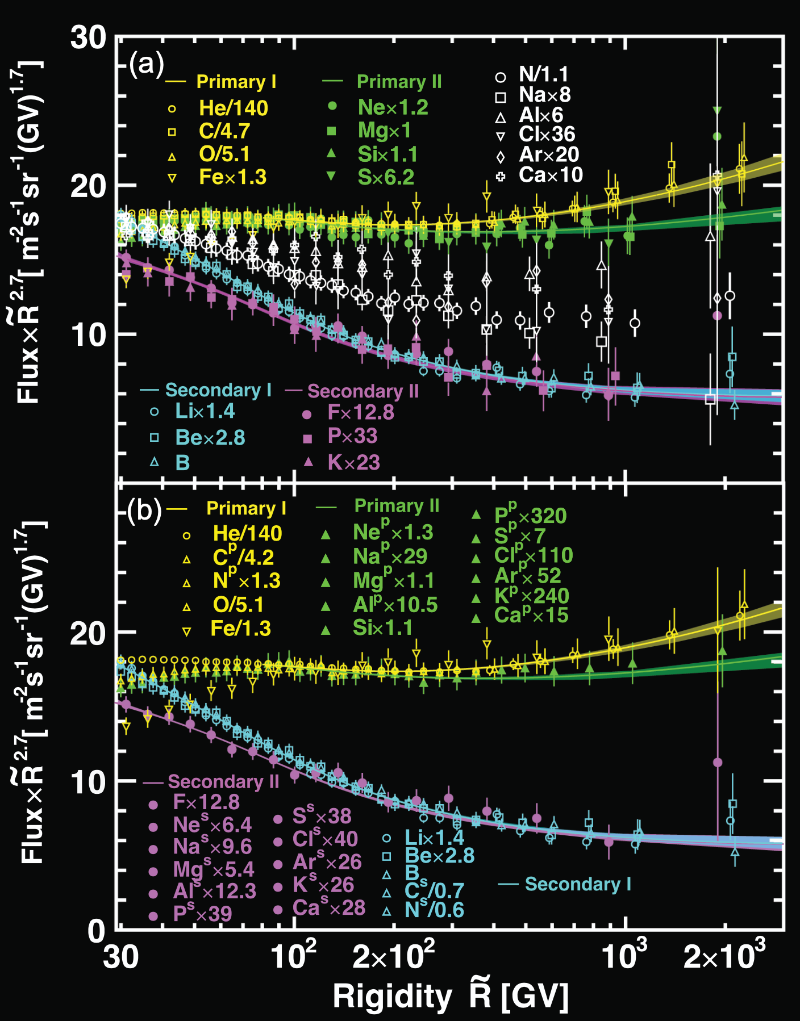
To address this gap, the research team screened one million nuclear samples of phosphorus, chlorine, argon, potassium and calcium from over 250 billion cosmic ray data entries captured by the AMS detector. The group overcame critical technical hurdles including the precise characterization of nuclear fragmentation cross-sections and background evaluation for heavy nuclear fragmentation. For the first time, the energy spectra of the five nuclei were measured across an energy range from 2.1 gigaelectronvolts to 3 teraelectronvolts. These observations represent the broadest energy coverage and highest precision measurements of phosphorus, chlorine, argon, potassium and calcium energy spectra achieved to date. This achievement marks a major leap forward for the AMS program toward its ultimate goal of fully mapping the cosmic periodic table of elements.
Further analysis revealed that all five types of cosmic rays contain both primary and secondary cosmic ray components. Even-numbered nuclei (argon and calcium) feature a markedly higher proportion of primary components compared with odd-numbered nuclei (phosphorus, chlorine and potassium). Drawing on energy spectrum data from the 20 nuclei previously measured, the team derived a universal pattern: based on spectral signatures, the 20 nuclei can be neatly categorized into two primary component groups and two secondary component groups. The team describes this as a groundbreaking new insight into the fundamental nature of cosmic rays and a landmark discovery for investigating the origin of cosmic elements.
(Reporter: Xiao Haichuan)
Source: Xinhua News Agency