


 Home
Samuel C. C. Ting Laboratory Proposes a Kurtosis-Difference Weighted Quantum Imaging Method, Boosting Quantum Microscopy Speed by 40-Fold
Release date: 2026-10-28
Visits: 2
Source: 山东高等技术研究院

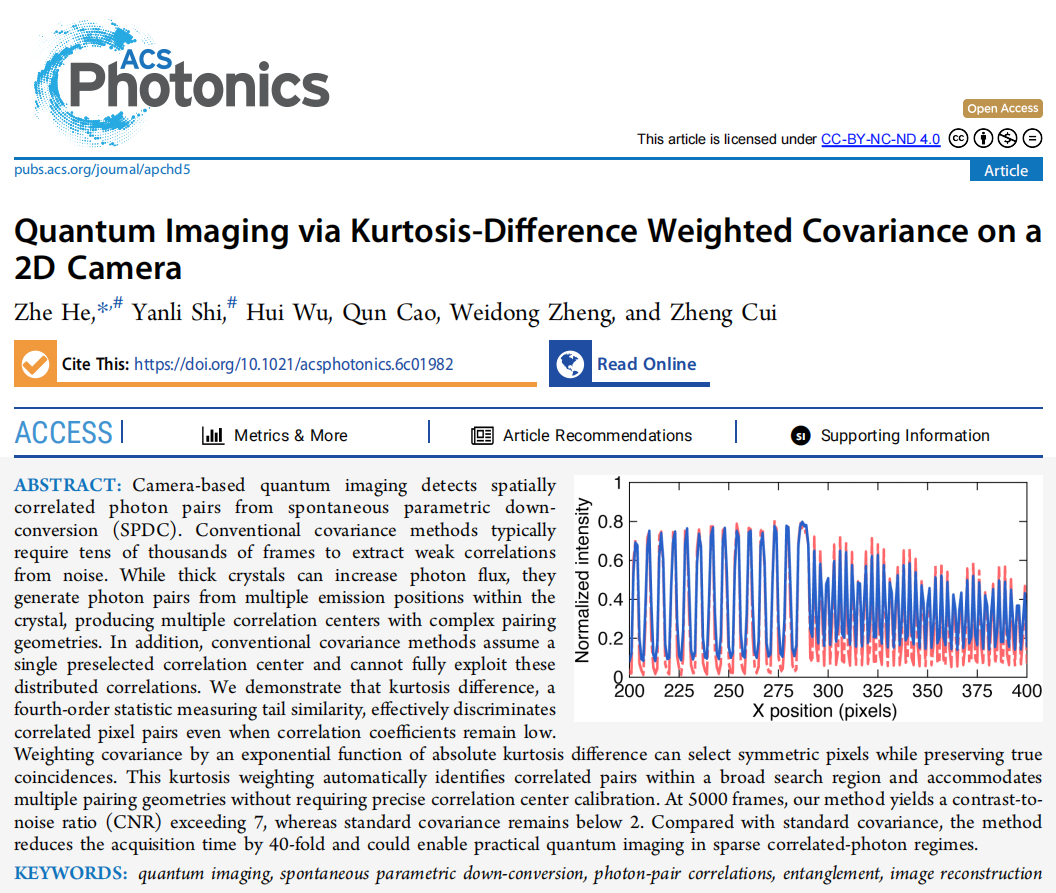
The Samuel C. C. Ting Laboratory at the Shandong Institute of Advanced Technology (SDIAT) has made important progress in quantum imaging. In camera-based quantum imaging, correlation signals are weak and slow to extract. To address this long-standing challenge, the team proposed a kurtosis-difference weighted covariance (KWC) reconstruction method that improves the data acquisition efficiency of quantum imaging by approximately 40-fold.
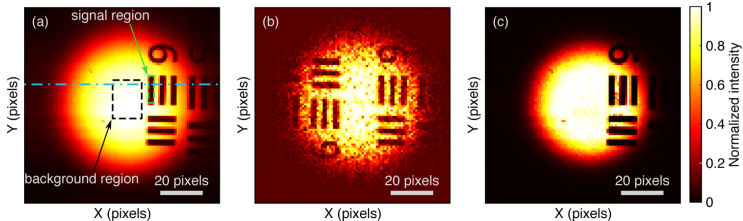
Figure 1. Comparison of imaging methods. (a) Classical imaging by accumulation (ACC). (b) Quantum imaging with standard covariance (COV). (c) Quantum imaging with kurtosis-difference weighted covariance (KWC).
The researchers exploited the statistical features of correlated photon pairs in their intensity distributions. They used the absolute kurtosis difference, a fourth-order statistic measuring tail similarity, as the criterion to weight the covariance. In this way, the method automatically identifies correlated pixel pairs across a broad search region, without requiring precise calibration of correlation centers, and enables fast and efficient image reconstruction. The team compared classical imaging, the conventional covariance method, and KWC. On a fine bar target, classical imaging can no longer resolve the stripes, whereas KWC retains clear image contrast (Fig. 2b,c). Moreover, KWC achieves with only 5,000 frames a noise level that the conventional covariance method needs 200,000 frames to reach (Fig. 2e), corresponding to a more than 40-fold speed-up in imaging.
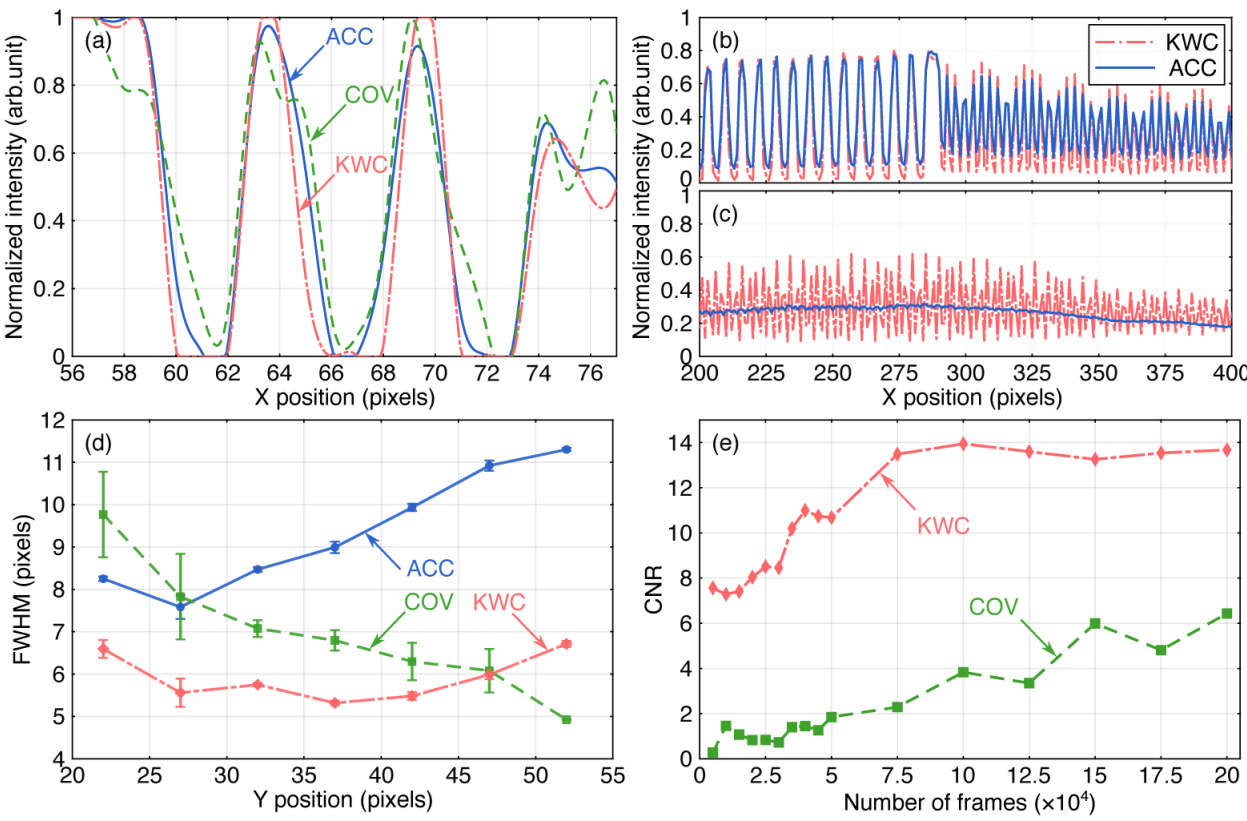
Figure 2. KWC improves imaging speed, resolution, and signal-to-noise ratio. ACC is the classical imaging result, and COV is quantum imaging based on the standard covariance method.
This work demonstrates that the kurtosis difference, a higher-order statistic, can effectively discriminate correlated pixel pairs even when correlation signals are extremely weak. It provides a universal reconstruction scheme for quantum imaging under low photon flux that requires no calibration of correlation centers. The method effectively resolves the tension between photon flux and correlation clarity in quantum imaging, and it opens a new technical route toward fast, low-photodamage quantum super-resolution microscopy. It is expected to play an important role in label-free bioimaging, quantum sensing, and other fields.
The related results were published in ACS Photonics under the title "Quantum Imaging via Kurtosis-Difference Weighted Covariance on a 2D Camera." Associate Research Scientist Zhe He and Assistant Research Scientist Yanli Shi are co-first authors of the paper, and Zhe He is also the corresponding author.
Paper link (DOI) https://doi.org/10.1021/acsphotonics.6c01982