


 Home
HomeShandong Institute of Advanced Technology Thermal Science Team Develops Nanofilm Optomechanical Thermometry
Release date: 2026-07-15
Visits: 169
Source: 山东高等技术研究院
Shandong Institute of Advanced Technology Thermal Science Team Develops Nanofilm Optomechanical Thermometry
The thermal science team at Shandong Institute of Advanced Technology has reported a new technique in optical thermometry. The team proposed and experimentally demonstrated a non-contact cryogenic thermometry method based on thermal-strain optomechanics in silicon nitride nanofilms, providing a noninvasive metrological approach for precision measurements at low temperatures. The work entitled “Cryogenic Thermometry via Nanofilm Thermal-Strain Optomechanics” was published in the top optics journal Photonics Research as Editor’s pick.
Cryogenic thermometry is usually limited by measurement induced heat loads. Conventional contact temperature measurement relies on temperature sensors, which introduce self-heating load and are susceptible to environmentally induced thermal drift. Therefore, a non-invasive approach with minimal thermal perturbation is highly desirable for cryogenic measurement. To address this challenge, the research team uses a silicon nitride nanofilm window and employs low power optical interferometry to measure the power spectral density of the thermomechanical vibrations and extract the resonance frequencies. Temperature variations modify the thermal stress of the nanofilm, thereby shifting its mechanical resonance frequencies. By establishing a quantitative frequency temperature relationship, this method maps temperature variations on optomechanical frequency shifts, enabling non-invasive thermometry without electrical contact.
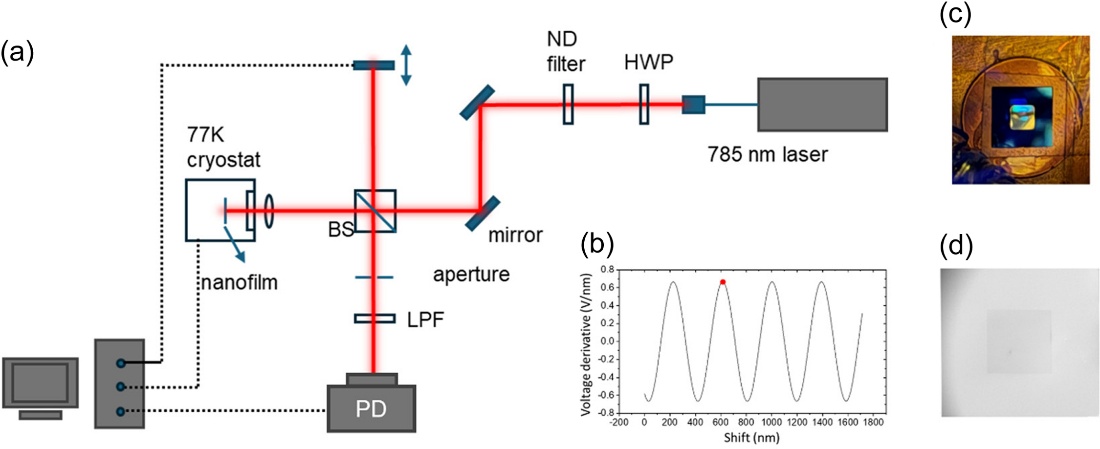
Fig 1 Experimental setup and suspended silicon nitride nanofilm
The experiments resolve several distinct vibrational modes of the silicon nitride nanofilm at cryogenic temperatures, with all modes exhibiting a pronounced transition point in their frequency response near 214 K. At temperatures above 214 K, the resonance frequencies increase with temperature. In contrast, they decrease linearly with temperature in the regime below 214 K, and the frequency temperature coefficient of the fundamental mode is approximately −122 Hz/K. By combining the linearly calibrated frequencies of multiple vibrational modes, the team achieves accurate temperature reconstruction over the range of 95–214 K with a mean absolute error of 208 mK.
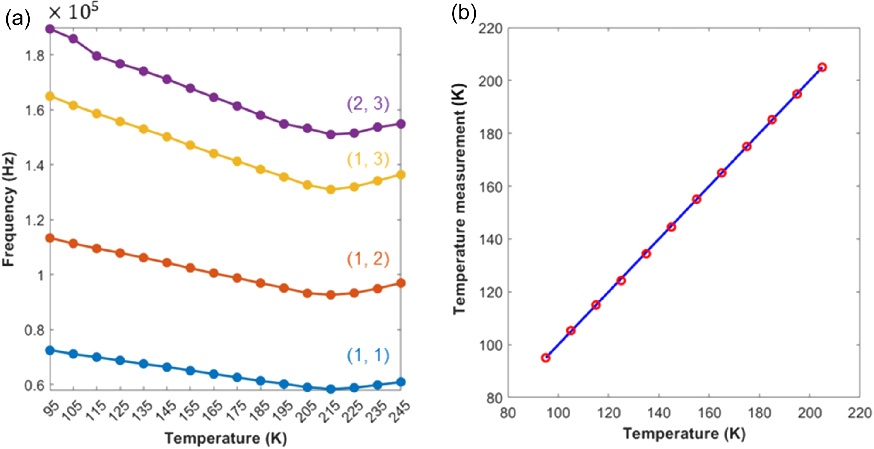
Fig 2 Temperature dependence of vibrational mode frequencies and multimode temperature reconstruction
This work exploits the temperature dependence of thermal expansion mismatch in silicon nitride nanofilms, clarifies their optomechanical response mechanism at cryogenic temperatures, and establishes a non-contact cryogenic thermometry method based on multimode frequency reconstruction. Building on these findings, the technique will be extended toward the 4 K regime and may provide a new metrological tool for cryogenic electronics, thermal management of quantum devices, and precision measurements at ultralow temperatures.
Article DOI: https://doi.org/10.1364/PRJ.590925
Guangyu Li, a PhD student at Shandong University, and Hui Wu, an engineer at Shandong Institute of Advanced Technology, are co-first authors. Qun Cao (Associate Research Scientist), Zhe He (Associate Research Scientist), and Zheng Cui (Senior Research Scientist) from Shandong Institute of Advanced Technology are co-corresponding authors.
- Deepening Industry-Research Integration to Empower Intelligent Material Manufacturing — Shandong Institute of Advanced Technology and Shenzhen Shengdian New Materials Co., Ltd. (Shinexcita) Co-build t
- Representatives of Faculty and Students from Shandong University Visit Shandong Institute of Advanced Technology for Research and Study